mercoledì 4 novembre 2009

venerdì 11 settembre 2009
Wikipedia versione in inglese
Ridolfo Capo Ferro
From Wikipedia, the free encyclopedia
Jump to: navigation, search
Ridolfo Capoferro or Capo Ferro of Cagli was a fencing master in the city of Siena who published a rapier fencing manual in Italian in 1610, entitled
"Great Simulacrum of the Art and Use of Fencing / by Ridolfo Capoferro of Cagli / Maestro of the Most High German Nation / In the Famous City of Siena / Dedicated to the most Serene Signore Don Federigo Feltrio delle Rovere / Prince of the State of Urbino."
Printed by Salvestro Marchetti and Camillo Turi in Siena, Ridolfo's origin is unclear. The reference to the Holy Roman Empire may indicate that he studied with masters of the German school. Cagli (in the Province of Pesaro e Urbino) appears to be his place of origin, while he was active as a fencing master in Siena (in Tuscany). Ridolfo's teachings, however, do not reflect perceptible German influence, but are soundly in the Italian tradition with a notable influence from the earlier Italian school of swordsmanship of the 1500s.
Capoferro's treatise is divided into two parts: Art and Practice. In the first part, he gives the general principles of swordsmanship and fencing, with the second part of his book covering actual techniques, described in text with accompanying illustrations. His work is interesting in that some methods that he denigrates in his theory he uses in his actions; most notably, he dismisses feints as dangerous or useless (depending upon the situation) and then uses them liberally in various actions in the second part of his book.
Ridolfo's book must have been reasonably popular, as it was reprinted several times, although not many of the fencing treatises written in the next generation mention him and those that do are not necessarily complimentary. An interesting example of this is Francesco Alfieri, who, in his 1640 treatise La Scherma, refers to Capoferro as Capo di Ferro (literally: 'Head of Iron'). However, he was strongly praised by later notable swordsman such as Egerton Castle who says in his 'Schools and Masters of Fence (1893)', "...but of all the Italian works on fencing none ever had such a share in fixing the principals of the science as 'Great Simulacrum of the Use of the Sword, by Ridolfo Capoferro", later adding "for once the title of the book fully represented its contents." A later edition of Capoferro's work also incorporated Biblical scenes drawn into the backgrounds of the plates.
The book covers the use of single rapier, including basic sword grappling, as well as Rapier and dagger, Rapier and cloak, and Rapier and Rotella, a most unusual combination for the period, though far more common in the tradition of swordsmanship of the 1500s which preceded it. The Rotella is a medium size concave round shield of approximately 60 cm in Diameter with two straps to hold it. Similar metal shields survive, particularly from Spain in this period, though very few from Italy, implying that these shields were made of a perishable material such as wood or leather or a composite of such materials. The manual also includes techniques for fighting against a left handed opponent.
While many modern reference books state that rapiers were either blunt on their edges or only had sharp edges in order to discourage blade grabs because they were not suitable for the cut, should be noted that nearly 30% of the techniques included in Capoferro's treatise use the cut as a primary or secondary option.
In the fictional work The Princess Bride by William Goldman, Inigo Montoya and The Man in Black duel atop the Cliffs of Insanity where they mention various fencing techniques they have studied, including those of Capoferro.
A Note on the Spelling of Capoferro: Because there is an apparent space in the name of the author in the original publication, Capoferro is often spelled as two words: Capo Ferro. However, a look at some sources where he is named or listed, such as in the works of other fencing masters (for example, see page 6 of Giuseppe Morsicato-Pallavicini's 1670 fencing treatise), Jacopo Gelli's fencing bibliography, Dr Anglo's book The Martial Arts of Renaissance Europe, the listing of his books in the US Library of Congress, the Latin form of his name over his portrait (Rodulphus Capoferrus), and the spelling of the surname in modern Italy does support that it is one word. Despite this, other sources of the time such as "Prima [e secundi] parte dell'Historia siciliana (1606)" clearly show the name spelt as two words. Other works such as "Bibliotheca Stoschiana sive Catalogus selectissimorum librorum quos Collegerat Philippvs Liber Baro De Stosch" (1759), have the name hyphernated (Capo-Ferro).
From Wikipedia, the free encyclopedia
Jump to: navigation, search
Ridolfo Capoferro or Capo Ferro of Cagli was a fencing master in the city of Siena who published a rapier fencing manual in Italian in 1610, entitled
"Great Simulacrum of the Art and Use of Fencing / by Ridolfo Capoferro of Cagli / Maestro of the Most High German Nation / In the Famous City of Siena / Dedicated to the most Serene Signore Don Federigo Feltrio delle Rovere / Prince of the State of Urbino."
Printed by Salvestro Marchetti and Camillo Turi in Siena, Ridolfo's origin is unclear. The reference to the Holy Roman Empire may indicate that he studied with masters of the German school. Cagli (in the Province of Pesaro e Urbino) appears to be his place of origin, while he was active as a fencing master in Siena (in Tuscany). Ridolfo's teachings, however, do not reflect perceptible German influence, but are soundly in the Italian tradition with a notable influence from the earlier Italian school of swordsmanship of the 1500s.
Capoferro's treatise is divided into two parts: Art and Practice. In the first part, he gives the general principles of swordsmanship and fencing, with the second part of his book covering actual techniques, described in text with accompanying illustrations. His work is interesting in that some methods that he denigrates in his theory he uses in his actions; most notably, he dismisses feints as dangerous or useless (depending upon the situation) and then uses them liberally in various actions in the second part of his book.
Ridolfo's book must have been reasonably popular, as it was reprinted several times, although not many of the fencing treatises written in the next generation mention him and those that do are not necessarily complimentary. An interesting example of this is Francesco Alfieri, who, in his 1640 treatise La Scherma, refers to Capoferro as Capo di Ferro (literally: 'Head of Iron'). However, he was strongly praised by later notable swordsman such as Egerton Castle who says in his 'Schools and Masters of Fence (1893)', "...but of all the Italian works on fencing none ever had such a share in fixing the principals of the science as 'Great Simulacrum of the Use of the Sword, by Ridolfo Capoferro", later adding "for once the title of the book fully represented its contents." A later edition of Capoferro's work also incorporated Biblical scenes drawn into the backgrounds of the plates.
The book covers the use of single rapier, including basic sword grappling, as well as Rapier and dagger, Rapier and cloak, and Rapier and Rotella, a most unusual combination for the period, though far more common in the tradition of swordsmanship of the 1500s which preceded it. The Rotella is a medium size concave round shield of approximately 60 cm in Diameter with two straps to hold it. Similar metal shields survive, particularly from Spain in this period, though very few from Italy, implying that these shields were made of a perishable material such as wood or leather or a composite of such materials. The manual also includes techniques for fighting against a left handed opponent.
While many modern reference books state that rapiers were either blunt on their edges or only had sharp edges in order to discourage blade grabs because they were not suitable for the cut, should be noted that nearly 30% of the techniques included in Capoferro's treatise use the cut as a primary or secondary option.
In the fictional work The Princess Bride by William Goldman, Inigo Montoya and The Man in Black duel atop the Cliffs of Insanity where they mention various fencing techniques they have studied, including those of Capoferro.
A Note on the Spelling of Capoferro: Because there is an apparent space in the name of the author in the original publication, Capoferro is often spelled as two words: Capo Ferro. However, a look at some sources where he is named or listed, such as in the works of other fencing masters (for example, see page 6 of Giuseppe Morsicato-Pallavicini's 1670 fencing treatise), Jacopo Gelli's fencing bibliography, Dr Anglo's book The Martial Arts of Renaissance Europe, the listing of his books in the US Library of Congress, the Latin form of his name over his portrait (Rodulphus Capoferrus), and the spelling of the surname in modern Italy does support that it is one word. Despite this, other sources of the time such as "Prima [e secundi] parte dell'Historia siciliana (1606)" clearly show the name spelt as two words. Other works such as "Bibliotheca Stoschiana sive Catalogus selectissimorum librorum quos Collegerat Philippvs Liber Baro De Stosch" (1759), have the name hyphernated (Capo-Ferro).
Rapisardi Giovanni Autore di Libri dell'autore: Capoferro Ridolfo
Libri dell'autore: Capoferro Ridolfo
Gran simulacro dell'arte e dell'uso della scherma
di Capoferro Ridolfo, Rapisardi Giovanni
20Euro
Gran simulacro dell'arte e dell'uso della scherma
di Capoferro Ridolfo, Rapisardi Giovanni
20Euro
sabato 1 agosto 2009
ITALIAN RAPIER COMBAT By Capo Ferro Edited and Presented by Jared Kirby

Recensioni su autore di questo testo in inglese che parla di RODOLFO CAPOFERRO da Cagli
"Jared Kirby has done a great service in bringing a modern edition of Capo Ferro to press, and this translation, executed by Mr. Kirby and the husband-and-wife team of fencing masters Ramon Martinez and Jeannette Acosta-Martinez, is an indispensible primary source for anyone with an interest in Renaissance martial arts or affairs of honor.
Overall, this is a handsome volume, a well-produced and much-needed text that is sure to be appreciated by all those touched by the romance and deadly skill of the rapier."
--Ken Mondschein, Renaissance Magazine
venerdì 31 luglio 2009
Tavole con combattimenti e paesaggi del Montefeltro e panorama di CAGLI

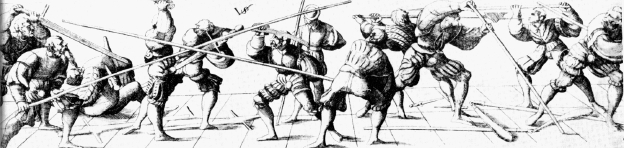
The ARMA is the Internet's Premier Educational Site for
the Study and Practice of Medieval and Renaissance Fighting Skills
Info su Rodolfo Capoferro da Cagli
Anche l'enciclopedia mediatica WIKIPEDIA ha una pagina dedicata al nostro cittadino , il grande fencing master originario di Cagli .
lunedì 8 giugno 2009
La A.S.D. Federazione Italiana Scherma Antica e Storica

Scuola italiana
Flos Duellatorum [ italiano ]
Fiore de Liberi, 1409
De Arte Gladiatoria Dimicandi [ italiano ]
Filippo Vadi, 1482
Petrii Montii Exercitiorum [ latino ]
Pietro Moncio (Monte) autore Spagnolo, 1509
Opera Nova per imparare a Combattere e Schermire... [ italiano ]
Antonio Manciolino, 1531
Opera Nova ... ( varie edizioni in diverse date e con diversi titoli) [ italiano ]
Achille Marozzo, 1536
Trattato di Scientia d'Arme con un Dialogo di Filosofia [ italiano ]
Camillo Agrippa, 1553
Discorso sopra l'Arte della Scherma [ italiano ]
Camillo Palladini, 1553
Ragione di adoprar sicuramente l'Arme [ italiano ]
Giacomo di Grassi, 1570
Dell'Arte di Scrimia [ italiano ]
Giovanni dall'Agocchie, 1572
Lo Schermo [ italiano ]
Angelo Viggiani, 1575
Regole di Molti Cavagliereschi Essercitii [ italiano ]
Federico Ghisliero, 1587
Opera intorno alla Practica et Theorica... [ italiano ]
Antonio Lovino, 1590
His True Arte of Defence [ inglese ]
Giacomo di Grassi, traduzione inglese del trattato italiano, 1594
Vincentio Saviolo - His Practise [ inglese ]
Vicenzo Saviolo, 1595
Trattato in materia di Scherma [ italiano ]
Marco Docciolini, 1601
De lo Schermo ovvero Scienza d'Armi [ italiano ]
Salvatore Fabris, 1606
Schola overo Teatro... [ italiano ]
Nicoletto Giganti, 1606
Traitè ou instruction pour tirer des armes [ francese ]
Cavalcabo e Paternostrier, 1609
Gran simulacro dell'Arte e dell'uso della Scherma [ italiano ]
Ridolfo Capoferro, 1610
Gioiello di Sapienza [ italiano ]
Antonio Quintino, 1614
Arte di maneggiare la Spada a piedi et a cavallo [ italiano ]
Giovan Battista Gaiani, 1619
La Scherma di Francesco Alfieri [ italiano ]
Francesco Alfieri, 1640
L'Esercizio della Spada Regolato con la Perfetta Idea della Scherma [ italiano ]
Terenziano Ceresa, 1641
Le Maistre d'Armes Liberal [ francese ]
Charles Besnard, 1653
Modi di metter mano alla Spada [ italiano ]
Alessandro Senesio, 1660
Della Scherma Napoletana [ italiano ]
Francesco Antonio Mattei, 1669
La Scherma Illustrata [ italiano ]
Morsicato Pallavicini, 1670
La scherma Siciliana ridotta in compendio... [ italiano ]
Giuseppe villardita, 1670
Trattato della scherma Siciliana... [ italiano ]
Giuseppe Villardita, 1673
La Scherma Napoletana [ italiano ]
Francesco Della Monica, 1680
Regole della Scherma [ italiano ]
Lelio /Titta/ Francesco Antonio Marcelli, 1686
Alimento...della scherma napolitana [ italiano ]
Nuzzo Francesco Giovanni, 1691
La Spada Maestra [ italiano ]
Bondi di Mazo, 1696
Massime ed Avvertimenti da praticarsi nella Scherma [ italiano ]
Paolo Capodivacca, 1704
L'Arte Maestra... [ italiano ]
Colombani, Giuseppe, 1711
Scienza prattica necessaria all'Huomo... [ italiano ]
Costantino Calarone, 1714
La Vera Scherma Napoletana [ italiano ]
Nicola Terracusa, 1725
Ragionamenti accademici intorno all'Arte... [ italiano ]
Alessandro di Marco, 1758
Elementi Della Scherma [ italiano ]
Marco Marcello Vandoni, circa, 1780
Riflessioni filosofiche sopra l'Arte della Scherma [ italiano ]
G.A. del Mangano, 1781
Componimento de la Scherma... [ italiano ]
Nicola di Gennardo, 1783
Trattato di Scherma [ italiano ]
Paolo Bartelli, 1800
La Scienza della Scherma [ italiano ]
Giuseppe Rossarol Scorza e Pietro Grisetti, 1803
Trattato sulla Scherma [ italiano ]
Michele Gambogi, 1837
Trattato di Sciabola [ italiano ]
Bartolomeo Bertolini, 1842
La Scienza della Scherma [ italiano ]
Blasco Florio, 1844
Tratato di Scherma relativo alla Spada [ italiano ]
Bartolomeo Bertolini, 1844
Fencing Throughout History
About the AHF
The Association for Historical Fencing is a 501(c)(3) tax-exempt not-for-profit educational corporation founded to meet the needs of the classical- and historical-oriented fencing community.
The AHF exists to encourage and preserve the arts of classical and historical fencing. To these ends, the AHF is organizing seminars, lectures, workshops and similar programs, and disseminating knowledge and basic factual material to its membership. To raise public awareness we are hosting exhibitions and demonstrations. The AHF, to the extent practicable, will ensure the availability of qualified masters and instructors in order to teach workshops, etc. We hope to promote the growth of schools and academies both nationally and internationally, but most importantly, we are providing a venue where practitioners and interested parties can unite to foment the growth of the classical and historical fencing community.
Fencing Throughout History
The Association for Historical Fencing has developed a system of classification of the eras of the history of fencing based on the various periods in the development of the art. They are:
Historical Fencing Early Period -- 14th and 15th Centuries
Historical Fencing Middle Period -- 16th Century
Historical Fencing Late Period -- 17th and 18th Centuries
Classical Fencing -- 19th Century
Modern Fencing -- 20th Century
These time periods are, of course, somewhat artificial classifications used to facilitate discussion, just as we may speak of vague periods such as "the Middle Ages" and "the Modern Era." Styles and weapons did not, of course, abruptly change from one time period to the next, just as other artifacts of human culture do not suffer sudden transformations. Rather, there was always an overlap of weapons, styles, and techniques within each era. Nonetheless, the different eras of the development of fencing can clearly be distinguished from each other, as each era has its own distinct characteristics. Comprehension of these developments and their ramifications is necessary for the informed practice thereof.
Historical Fencing Early Period
Though we may trace the art of defense back to the 14th century, it is difficult to talk about fencing before that time since there is simply no surviving documentation, save for anecdotal evidence. The fechtbuch known as I-33, penned circa 1300, is the first known treatise on Western swordsmanship. However, specifics on styles, techniques, or methods that predate this are, due to the lack of documentation, open to speculation. Most importantly, there was no clear distinction between civilian and military use of the sword. The early treatises do, however, contain clear descriptions of timing, distance, binding, engagements, parries, feints, voiding actions, and footwork. The basics of the styles within the "middle historical" period can be traced to this time period.
The I-33 fechtbuch is also the earliest known documented evidence of the use of the sword for personal self-defense or for monomachia (that is, dueling), though the distinction between civilian swordsmanship and military swordsmanship was just beginning to be recognized in this period. These two aims—self-defense and dueling—have guided the development of the art of fence through the centuries. The attitude and techniques that are necessary to these ends differ in many ways from those of military swordsmanship. Thus this distinction is of no small importance.
Historical Fencing Middle Period
The 16th century may, in fact, be considered to be a long transitional period. It is to this period that the basics of the "late historical" period can be traced, as well as the final developments of the styles and schools of the "early historical" period. It is within this period that the use of the sword as a civilian side arm became common practice, first appearing in fifteenth-century Spain. However, though we have texts on swordsmanship from the fifteenth century, it is not until the sixteenth century that we find numerous surviving treatises clearly documenting civilian systems of swordsmanship. In this period we find both the explication and definition of a system that already existed in the 15th century in the work of Achille Marozzo, and, seventeen years later, the explication of a new approach and system in the writings of Camillo Aggrippa. The sixteenth century also saw the birth of an entirely new civilian school in Spain with the writings of Don Jeronimo de Carranza.
Historical Fencing Late Period
The late historical period may be distinguished from the early and middle periods by the fact that we may directly trace the origins of the traditional schools, styles, and techniques of the classical era to this time period. This development can be attributed to several factors: the growing influence of the printing press, the beginnings of a modern mentality that included national consciousness and a "scientific" mindset, the rise of the middle class, and the wearing of the sword as an everyday article of dress. These social changes had their affect on fencing, as they did on other areas of human endeavor. Specifically, the printing press and the greater ease of long-distance travel helped the transmission of both first-person and vicarious knowledge, while the growth of the urban leisure class gave the fencing master a steady stream of willing patrons.
The late historical period is the era in which fencing evolved into distinct schools specifically intended for civilian use. This development resulted in schools and styles that remained intact for long periods of time, and a direct line that may be drawn from the classical techniques to the systems already in use in this era. In short, this is the era in which a differentiation between military and civilian styles were clearly established, and national styles, such as the Spanish, Italian, and French schools, became clearly defined. Finally, the schools of thought regarding the subject, which may be documented through the printed materials left to us, can be discerned, and the origin of traditions that have come down to this very day may be positively identified.
We know, for example, that rapier technique had its birth in the late 16th century, while the 17th century was the golden age of this weapon. The 17th century also saw the development of the smallsword, but it wasn't until the 18th century that we see the full development of l'escrime français, in which, primarily under the leadership of French masters, the smallsword developed into its own distinctive system. The Italian school also developed greatly during the 18th century, but continued to adhere to the method of the striccia, or thrusting rapier, as the basis of its system.
Classical Fencing
The second half of the 19th Century is historically the classical period, in which the art of fencing reached its highest development, but we may include the whole of the 19th century in this era, as this was the age when fencing was formally codified, systematized, and fully expressed in complete systems and styles. "Classical," in this sense, means "the golden age," the period when the art saw its highest peak. Clear distinctions between the French and Italian schools can be seen in this era, and national "academies" were established. A "super-national" approach established commonality in fencing language, as well as codes and rules for dueling. It is also within the classical period that the great rivalries between both schools were constantly put to the test through professional bouts and, in some cases, duels between masters of each school.
The use of the sword as a sidearm, for personal self-defense, was no longer a concern of fencers during this era. Rather, they focused on training in fencing for its own sake as an art form and personal accomplishment, in addition its use in personal combat. This age is distinguished by the art of the foil, which masters thought to be the fencing "weapon" par excellence. With this refined tool, the most sophisticated and artistic maneuvers are possible. However, the use of the sword as a killing weapon was always borne in mind, and the training was serious in nature.
However, earlier, more combative, techniques did not die out. In the early part of the 19th century, methods such as the use of the unarmed hand, strikes with the pommel, disarms, arm locks, and the like could be found in such works as Rosaroll and Grisetti's treatise of 1803 and Maestro Brea's book of 1805. It is also well known that methods of rapier and dagger, as well as other "historical" weapons, were practiced through the 19th century and into the 20th.
Modern Fencing
This brings us to the era we term "modern." This period has seen the gradual disappearance of the duel and, with the lack of a need to prepare for mortal combat, the transformation of the discipline into a sport. Although there have been occasional duels within the 20th century, modern fencing is solely concerned with the "sport" aspect. This development was aided by the inclusion of fencing into the first modern Olympic Games in 1896.
Furthermore, the founding of the Federation Internationale d'Escrime in 1913 saw a growth of "technicism" and the loss of the principles that are first and basic to the practice of fencing in a martial context. These principles are, namely, self-preservation, conservation, and defense. Fencing pedagogy has also changed with this. The fleche, the fouettee ("flick"), and similar actions, along with the use of the electrical scoring system and orthopedic grips, have no relation to preparation for lethal combat. These innovations, along with the constantly changing and subjectively reinterpreted rules, have resulted in the metamorphosis of the art and science of the sword into an athletic game. The final moments of the 20th century therefore find fencing severely altered from its original form and intent from a killing art, where the stakes are life and death, into a game, where losing a bout is the worst that can happen.
To conclude, it must be said that we have seen many misapprehensions such as classical fencing being confused with historical fencing, or anything that is not modern fencing classified as classical fencing, or, worse, theatrical swordplay. We hope everyone will now understand what context we are referring to when we speak of a specific era. It is important not only that we differentiate time periods, but also that we know the historical and technical reasons for these categorizations. Thus, we can use the same terminology and avoid unnecessary confusion.
The Association for Historical Fencing is a 501(c)(3) tax-exempt not-for-profit educational corporation founded to meet the needs of the classical- and historical-oriented fencing community.
The AHF exists to encourage and preserve the arts of classical and historical fencing. To these ends, the AHF is organizing seminars, lectures, workshops and similar programs, and disseminating knowledge and basic factual material to its membership. To raise public awareness we are hosting exhibitions and demonstrations. The AHF, to the extent practicable, will ensure the availability of qualified masters and instructors in order to teach workshops, etc. We hope to promote the growth of schools and academies both nationally and internationally, but most importantly, we are providing a venue where practitioners and interested parties can unite to foment the growth of the classical and historical fencing community.
Fencing Throughout History
The Association for Historical Fencing has developed a system of classification of the eras of the history of fencing based on the various periods in the development of the art. They are:
Historical Fencing Early Period -- 14th and 15th Centuries
Historical Fencing Middle Period -- 16th Century
Historical Fencing Late Period -- 17th and 18th Centuries
Classical Fencing -- 19th Century
Modern Fencing -- 20th Century
These time periods are, of course, somewhat artificial classifications used to facilitate discussion, just as we may speak of vague periods such as "the Middle Ages" and "the Modern Era." Styles and weapons did not, of course, abruptly change from one time period to the next, just as other artifacts of human culture do not suffer sudden transformations. Rather, there was always an overlap of weapons, styles, and techniques within each era. Nonetheless, the different eras of the development of fencing can clearly be distinguished from each other, as each era has its own distinct characteristics. Comprehension of these developments and their ramifications is necessary for the informed practice thereof.
Historical Fencing Early Period
Though we may trace the art of defense back to the 14th century, it is difficult to talk about fencing before that time since there is simply no surviving documentation, save for anecdotal evidence. The fechtbuch known as I-33, penned circa 1300, is the first known treatise on Western swordsmanship. However, specifics on styles, techniques, or methods that predate this are, due to the lack of documentation, open to speculation. Most importantly, there was no clear distinction between civilian and military use of the sword. The early treatises do, however, contain clear descriptions of timing, distance, binding, engagements, parries, feints, voiding actions, and footwork. The basics of the styles within the "middle historical" period can be traced to this time period.
The I-33 fechtbuch is also the earliest known documented evidence of the use of the sword for personal self-defense or for monomachia (that is, dueling), though the distinction between civilian swordsmanship and military swordsmanship was just beginning to be recognized in this period. These two aims—self-defense and dueling—have guided the development of the art of fence through the centuries. The attitude and techniques that are necessary to these ends differ in many ways from those of military swordsmanship. Thus this distinction is of no small importance.
Historical Fencing Middle Period
The 16th century may, in fact, be considered to be a long transitional period. It is to this period that the basics of the "late historical" period can be traced, as well as the final developments of the styles and schools of the "early historical" period. It is within this period that the use of the sword as a civilian side arm became common practice, first appearing in fifteenth-century Spain. However, though we have texts on swordsmanship from the fifteenth century, it is not until the sixteenth century that we find numerous surviving treatises clearly documenting civilian systems of swordsmanship. In this period we find both the explication and definition of a system that already existed in the 15th century in the work of Achille Marozzo, and, seventeen years later, the explication of a new approach and system in the writings of Camillo Aggrippa. The sixteenth century also saw the birth of an entirely new civilian school in Spain with the writings of Don Jeronimo de Carranza.
Historical Fencing Late Period
The late historical period may be distinguished from the early and middle periods by the fact that we may directly trace the origins of the traditional schools, styles, and techniques of the classical era to this time period. This development can be attributed to several factors: the growing influence of the printing press, the beginnings of a modern mentality that included national consciousness and a "scientific" mindset, the rise of the middle class, and the wearing of the sword as an everyday article of dress. These social changes had their affect on fencing, as they did on other areas of human endeavor. Specifically, the printing press and the greater ease of long-distance travel helped the transmission of both first-person and vicarious knowledge, while the growth of the urban leisure class gave the fencing master a steady stream of willing patrons.
The late historical period is the era in which fencing evolved into distinct schools specifically intended for civilian use. This development resulted in schools and styles that remained intact for long periods of time, and a direct line that may be drawn from the classical techniques to the systems already in use in this era. In short, this is the era in which a differentiation between military and civilian styles were clearly established, and national styles, such as the Spanish, Italian, and French schools, became clearly defined. Finally, the schools of thought regarding the subject, which may be documented through the printed materials left to us, can be discerned, and the origin of traditions that have come down to this very day may be positively identified.
We know, for example, that rapier technique had its birth in the late 16th century, while the 17th century was the golden age of this weapon. The 17th century also saw the development of the smallsword, but it wasn't until the 18th century that we see the full development of l'escrime français, in which, primarily under the leadership of French masters, the smallsword developed into its own distinctive system. The Italian school also developed greatly during the 18th century, but continued to adhere to the method of the striccia, or thrusting rapier, as the basis of its system.
Classical Fencing
The second half of the 19th Century is historically the classical period, in which the art of fencing reached its highest development, but we may include the whole of the 19th century in this era, as this was the age when fencing was formally codified, systematized, and fully expressed in complete systems and styles. "Classical," in this sense, means "the golden age," the period when the art saw its highest peak. Clear distinctions between the French and Italian schools can be seen in this era, and national "academies" were established. A "super-national" approach established commonality in fencing language, as well as codes and rules for dueling. It is also within the classical period that the great rivalries between both schools were constantly put to the test through professional bouts and, in some cases, duels between masters of each school.
The use of the sword as a sidearm, for personal self-defense, was no longer a concern of fencers during this era. Rather, they focused on training in fencing for its own sake as an art form and personal accomplishment, in addition its use in personal combat. This age is distinguished by the art of the foil, which masters thought to be the fencing "weapon" par excellence. With this refined tool, the most sophisticated and artistic maneuvers are possible. However, the use of the sword as a killing weapon was always borne in mind, and the training was serious in nature.
However, earlier, more combative, techniques did not die out. In the early part of the 19th century, methods such as the use of the unarmed hand, strikes with the pommel, disarms, arm locks, and the like could be found in such works as Rosaroll and Grisetti's treatise of 1803 and Maestro Brea's book of 1805. It is also well known that methods of rapier and dagger, as well as other "historical" weapons, were practiced through the 19th century and into the 20th.
Modern Fencing
This brings us to the era we term "modern." This period has seen the gradual disappearance of the duel and, with the lack of a need to prepare for mortal combat, the transformation of the discipline into a sport. Although there have been occasional duels within the 20th century, modern fencing is solely concerned with the "sport" aspect. This development was aided by the inclusion of fencing into the first modern Olympic Games in 1896.
Furthermore, the founding of the Federation Internationale d'Escrime in 1913 saw a growth of "technicism" and the loss of the principles that are first and basic to the practice of fencing in a martial context. These principles are, namely, self-preservation, conservation, and defense. Fencing pedagogy has also changed with this. The fleche, the fouettee ("flick"), and similar actions, along with the use of the electrical scoring system and orthopedic grips, have no relation to preparation for lethal combat. These innovations, along with the constantly changing and subjectively reinterpreted rules, have resulted in the metamorphosis of the art and science of the sword into an athletic game. The final moments of the 20th century therefore find fencing severely altered from its original form and intent from a killing art, where the stakes are life and death, into a game, where losing a bout is the worst that can happen.
To conclude, it must be said that we have seen many misapprehensions such as classical fencing being confused with historical fencing, or anything that is not modern fencing classified as classical fencing, or, worse, theatrical swordplay. We hope everyone will now understand what context we are referring to when we speak of a specific era. It is important not only that we differentiate time periods, but also that we know the historical and technical reasons for these categorizations. Thus, we can use the same terminology and avoid unnecessary confusion.
lunedì 1 giugno 2009
Swinging swords Italian
Italian Rapier in the style of Ridolfo Capo Ferro at AEMMA
AEMMA is pleased to announce the addition of Italian rapier to its curriculum. Although the Academy focuses on the medieval fighting arts as defined by Italian swordsmaster Fiore dei Liberi (1410), the fortunate circumstance of Mr. Beau Brock, hailing from Vancouver, and instructor at Academie Duello, is now
Instructor Mr. Beau Brock
attending the University of Toronto, working on his post doctoral degree focused on societal languages. During his studies in Toronto, the opportunity presented itself to leverage his skills and expertise in Italian rapier, and his passion for Ridolfo Capo Ferro manifested into a popular rapier class now scheduled on Wednesday evenings between 9 - 10:30pm.
AEMMA is pleased to announce the addition of Italian rapier to its curriculum. Although the Academy focuses on the medieval fighting arts as defined by Italian swordsmaster Fiore dei Liberi (1410), the fortunate circumstance of Mr. Beau Brock, hailing from Vancouver, and instructor at Academie Duello, is now
Instructor Mr. Beau Brock
attending the University of Toronto, working on his post doctoral degree focused on societal languages. During his studies in Toronto, the opportunity presented itself to leverage his skills and expertise in Italian rapier, and his passion for Ridolfo Capo Ferro manifested into a popular rapier class now scheduled on Wednesday evenings between 9 - 10:30pm.
mercoledì 4 marzo 2009

domenica 1 marzo 2009


sabato 28 febbraio 2009
I miei filmati su Yuotube


In questi anni , dopo la pensione dalla mia attività di insegnante , mi sono dedicato al Birdwatching e alle riprese naturalistiche cercando di documentare il nostro territorio . Ho in questi 5 anni raccolto Gigabyte di filmati DV. Su questa pagina di YouTube ne potete vedere alcuni.
sabato 31 gennaio 2009
Academy of European Medioval Tornament
about AEMMA
bout AEMMA
The Academy of European Medieval Martial Arts or AEMMA (pronounced "ehma"), is a historical European martial arts school focused on the research, reconstruction and resurrection of authentic medieval martial arts of all fighting styles (armed, unarmed, armoured and unarmoured), firmly based on the works of the late 14th century Friulian swordsmaster by the name of Fiore dei Liberi, demonstrating the deadly practicality and effectiveness of the art as it applies to today's personal self-defense.
AEMMA was initially created in May of 1998 in Toronto and under the laws of Ontario's Corporations Act and the Regulations of the Ministry of the Attorney General, was incorporated as a not-for-profit corporation (NPO Corporation Number: 1468524) in May 28, 2001. It has as its mission:
"The mission of AEMMA is to resurrect the combat skills, philosophies and principles of an accomplished European Medieval martial artist and to achieve a state which would be consistent with that of a medieval warrior in both technology and ideal."
The Academy of European Medieval Martial Arts or AEMMA (pronounced "ehma"), is a historical European martial arts school focused on the research, reconstruction and resurrection of authentic medieval martial arts of all fighting styles (armed, unarmed, armoured and unarmoured), firmly based on the works of the late 14th century Friulian swordsmaster by the name of Fiore dei Liberi, demonstrating the deadly practicality and effectiveness of the art as it applies to today's personal self-defense.
AEMMA was initially created in May of 1998 in Toronto and under the laws of Ontario's Corporations Act and the Regulations of the Ministry of the Attorney General, was incorporated as a not-for-profit corporation (NPO Corporation Number: 1468524) in May 28, 2001. It has as its mission:
"The mission of AEMMA is to resurrect the combat skills, philosophies and principles of an accomplished European Medieval martial artist and to achieve a state which would be consistent with that of a medieval warrior in both technology and ideal."
bout AEMMA
The Academy of European Medieval Martial Arts or AEMMA (pronounced "ehma"), is a historical European martial arts school focused on the research, reconstruction and resurrection of authentic medieval martial arts of all fighting styles (armed, unarmed, armoured and unarmoured), firmly based on the works of the late 14th century Friulian swordsmaster by the name of Fiore dei Liberi, demonstrating the deadly practicality and effectiveness of the art as it applies to today's personal self-defense.
AEMMA was initially created in May of 1998 in Toronto and under the laws of Ontario's Corporations Act and the Regulations of the Ministry of the Attorney General, was incorporated as a not-for-profit corporation (NPO Corporation Number: 1468524) in May 28, 2001. It has as its mission:
"The mission of AEMMA is to resurrect the combat skills, philosophies and principles of an accomplished European Medieval martial artist and to achieve a state which would be consistent with that of a medieval warrior in both technology and ideal."
The Academy of European Medieval Martial Arts or AEMMA (pronounced "ehma"), is a historical European martial arts school focused on the research, reconstruction and resurrection of authentic medieval martial arts of all fighting styles (armed, unarmed, armoured and unarmoured), firmly based on the works of the late 14th century Friulian swordsmaster by the name of Fiore dei Liberi, demonstrating the deadly practicality and effectiveness of the art as it applies to today's personal self-defense.
AEMMA was initially created in May of 1998 in Toronto and under the laws of Ontario's Corporations Act and the Regulations of the Ministry of the Attorney General, was incorporated as a not-for-profit corporation (NPO Corporation Number: 1468524) in May 28, 2001. It has as its mission:
"The mission of AEMMA is to resurrect the combat skills, philosophies and principles of an accomplished European Medieval martial artist and to achieve a state which would be consistent with that of a medieval warrior in both technology and ideal."
giovedì 29 gennaio 2009
I miei video su YuoTube
Presento su Youtube alcuni dei miei video naturalistici del territorio comunale di Cagli
mercoledì 28 gennaio 2009
Pagine Web con simulazioni tecniche Gran simulacro
Plate 7's Intelligent Play (falso followed by mandritto) from Capo Ferro's Gran Simulacro
Combattimenti in video
Ridolfo Capo Ferro ("ironhead") of Cagli was a fencing master in the city of Siena who published a rapier fencing manual in Italian in 1610, entitled - "Great Representation of the Art and Use of Fencing / by Ridolfo Capo Ferro of Cagli / Maestro of the Most High German Nation / In the Famous City of Siena / Dedicated to the most Serene Signore Don Federigo Feltrio delle Rovere / Prince of the State of Urbino."
lunedì 26 gennaio 2009


Manoscitto Originale Gran Simulacro
http://mac9.ucc.nau.edu/manuscripts/capoferro.pdf
Su questo link si puo' visionare e scaricare le immagini originali del testo di Rodolfo Capoferro da Cagli in formato pdf.
Il testo è in vendita come originale sul sito di Amazon http://www.amazon.co.uk/Italian-Rapier-Combat-Ferros-Simulacro/dp/1853675806 a 615 euro.
La copia moderna è in vendita sul sito http://www.lultimodeitemplari.com/node/1681 o sul sito www.senecaedizioni.com/index.php?pageid=prodotti&prodottiid=34 - 32k
Usate un motore di ricerca e avrete sorprese su quanto sia conosciuto questo nostro Grande concittadino


Iscriviti a:
Post (Atom)
